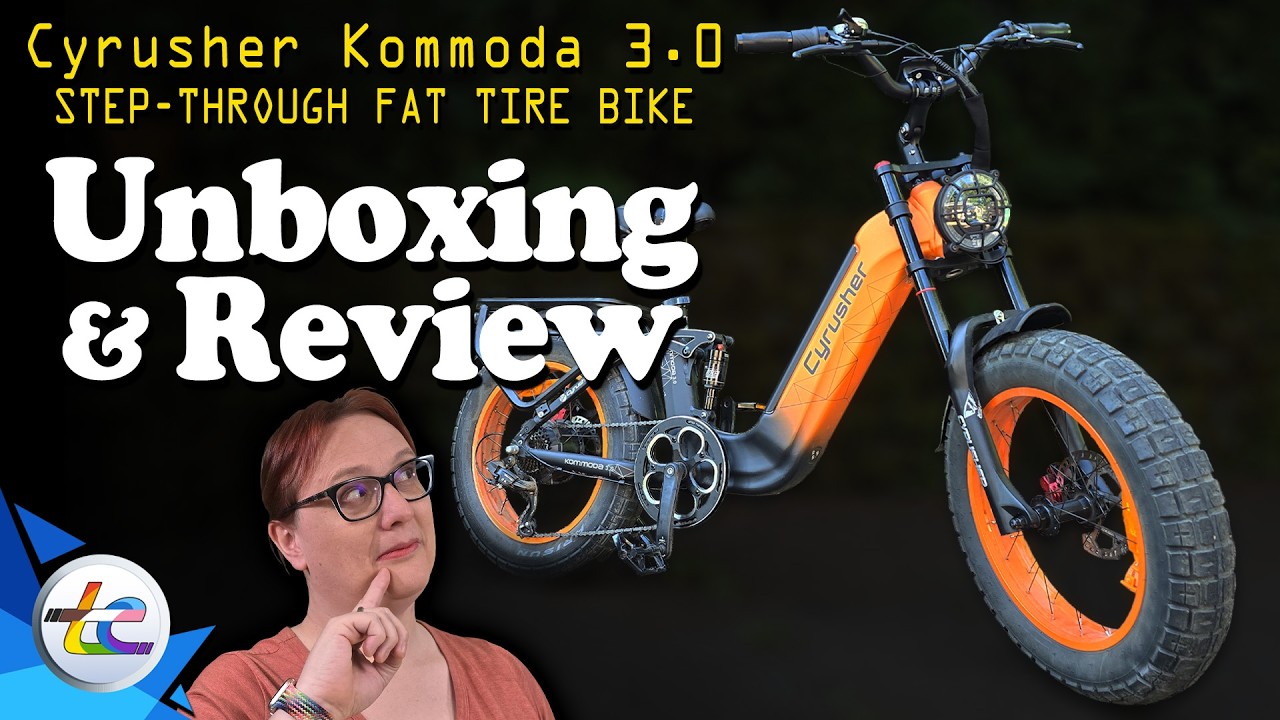
This video is an in-depth review of the Cyrusher Kommoda 3.0 e-bike, presented by the YouTube channel Transport Evolved. Drawing on extensive personal riding experience, the reviewer provides a comprehensive analysis of this fat-tire, step-through e-bike, covering everything from unboxing and specifications to ride quality, battery range, and value for money.
Key Video Summary
Positioning and Design: The Cyrusher Kommoda 3.0 is a “lifestyle” e-bike designed to handle leisure, recreation, off-road riding, and cargo hauling. Although it is heavy (approx. 83 lbs / 37.6 kg), its 750W rear motor and full suspension system—featuring a rear air shock—deliver excellent stability and handling at low speeds.
Riding Performance: Despite the use of compact 20x4-inch fat tires—which the reviewer initially feared might make handling twitchy or strenuous—the actual performance was a pleasant surprise. The torque sensor responds quickly, allowing for effortless flat-ground cruising even without power assist engaged.
Main Drawbacks: The bike’s excessive weight makes it incompatible with standard repair stands; the odometer has a discrepancy of about 3 miles; and the Battery Management System (BMS) relies on voltage rather than coulomb counting to track charge, leading to “voltage sag”—where the battery percentage drops sharply under heavy loads, such as hill climbing.
Conclusion: With an official list price of $1,999 (and promotional discounts available at the time of review), it is highly competitive among models offering similar specs and UL safety certification. The reviewer considers it one of the best e-bikes he has ridden recently, making it an ideal choice for weekend outings, RV camping companions, or users requiring heavy-duty hauling capabilities.
Detailed Timeline Analysis
[00:00] - Personal Background and Introduction
The reviewer shares his history as an avid cyclist (once riding 20–50 miles daily while hauling musical instruments) and mentions his regular use of a Peloton stationary bike. He notes that this background in high-intensity cycling serves as the benchmark for evaluating the Cyrusher Kommoda 3.0. [01:08] - Conflict of Interest Disclaimer
The reviewer discloses that the bike is a complimentary unit provided by the manufacturer (Gifted Review) but emphasizes that the brand had no editorial control prior to the video’s release, ensuring the review remains strictly objective and neutral.
[01:53] - Key Specifications and Parameters
An overview of the bike’s basic specs: 20x4-inch all-terrain fat tires, a 48V 20Ah NCM lithium battery (concealed within the frame and removable via a key lock), and a standard 48V 3A charger that takes approximately 6–7 hours for a full charge.
[02:44] - Unboxing and a Costly Mishap
Footage of the unboxing process. The bike arrives 85% pre-assembled, requiring only the installation of the front wheel and handlebars. The reviewer shares a painful lesson learned: while cutting the cable ties with a utility knife, he accidentally slashed and ruined the brand-new front tire, forcing him to order a replacement tire from Amazon and patch the inner tube himself.
[04:43] - Machining Quality and Assembly Challenges
The reviewer praises the quality of the machining—specifically the mounting holes and threading—noting the absence of any metal shavings or debris. However, due to the bike’s substantial 83-pound weight, standard bicycle repair stands cannot support it, making it very difficult for one person to install the front wheel without using a stand.
[05:39] - Handlebar Assembly, Brakes, and Total Weight
The handlebars feature an ergonomic design that provides excellent palm support. The bike is equipped with 180mm dual disc brakes (front and rear) and includes screws for fine-tuning the hydraulic brake bite point. Weighing in at 83 pounds, the bike requires attention to weight limits when loading it onto a pickup truck or bike rack.
[07:26] - Lighting, Horn, and Regulatory Classification
Front and rear lights come standard, with the taillight integrated into the sturdy cargo rack. The handlebars are equipped with a very loud horn. In most regions, this qualifies as a Class 3 e-bike; in some overseas markets, however, its speed and design classify it as a moped, requiring a license plate mount.
[08:40] - Drivetrain and Suspension Design
On the right side is a Shimano 7-speed trigger shifter, which comes precisely tuned from the factory. A major highlight is the suspension setup, combining an adjustable front fork (mechanical/hydraulic) with an adjustable rear gas shock, supporting a maximum load of 350 lbs (approx. 159 kg).
[10:40] - Pedals, Saddle, and Taillight Details
The stock pedals are better suited for flat-footed riding rather than the ball-of-the-foot pedaling technique used by serious cyclists. The seat height is highly adjustable (accommodating riders up to 195cm tall), and the saddle is wide and breathable. One minor downside: when the night-riding lights are on, the taillight does not brighten or flash additionally when the brakes are applied.
[13:12] - Real-World Riding: Flat-Ground Cruising and Power Delivery
Real-world testing completely dispelled the reviewer’s prejudice that “small, wide tires are sluggish and hard to handle.” The 750W rear hub motor performs excellently on flat roads. The 3.7-inch color display remains clearly visible in sunlight and offers five levels of pedal assist (0–5). In the US market, torque sensor mode is enabled by default, with a power engagement lag of only about 0.25–0.5 seconds. The reviewer prefers riding in “Level 0” (purely manual) mode, switching to an assist level only for a “boost” when encountering traffic lights or uphill sections.
[16:48] - Hidden Display Functions and Walk Mode
The reviewer noted a discrepancy between the manual and actual operation: long-pressing the “Up” button didn’t access ride statistics but instead toggled between torque and cadence/speed sensor modes. Long-pressing the “Down” button while stationary activates “Walk Mode”; however, in North America, the right brake lever (controlling the rear brake) cuts power to the walk-assist motor—potentially causing a conflict between the front brake and rear motor if the rider is accustomed to the reverse brake-cable configuration common in some other countries. Additionally, the cruise control feature does not appear to be enabled in the current software version.
[19:30] - Real-world range testing and the “voltage sag” issue
The official range is stated as 50–68 miles. The reviewer conducted real-world tests on mixed terrain in the hills of Portland (including gravel roads and elevation changes ranging from 200 to 1,100 feet). He found that the bike’s odometer overestimated the actual distance traveled by approximately 3 miles.
During a second test, while the bike was under load climbing a hill,
the battery level dropped suddenly from 54% to 36% in a short period, then rebounded to 47% once the ride leveled out on the descent. The reviewer contacted Cyrusher regarding this; the company explained that because the Battery Management System (BMS) estimates charge based on voltage rather than using precise Coulomb counting, “voltage sag” caused by heavy loads is a common occurrence in this class of e-bikes.
[24:52] - Recommended users and use cases
While not ideal for long-distance commuting, it is perfect for short city trips (like grocery runs), weekend outings, or as a transport vehicle to carry on the back of an RV during camping trips. Its robust frame and rear rack also make it well-suited for mounting a child seat for school runs or errands.
[27:00] - Price, safety certifications, and conclusion
The official MSRP is $1,999. All electronic components and the battery have passed
UL safety certification, and the bike holds an IP65 waterproof rating. Among e-bikes in the $1,500–$2,000 price range, its build quality, safety features, and value for money make it highly competitive, earning a strong recommendation from the reviewer.