- Video Summary
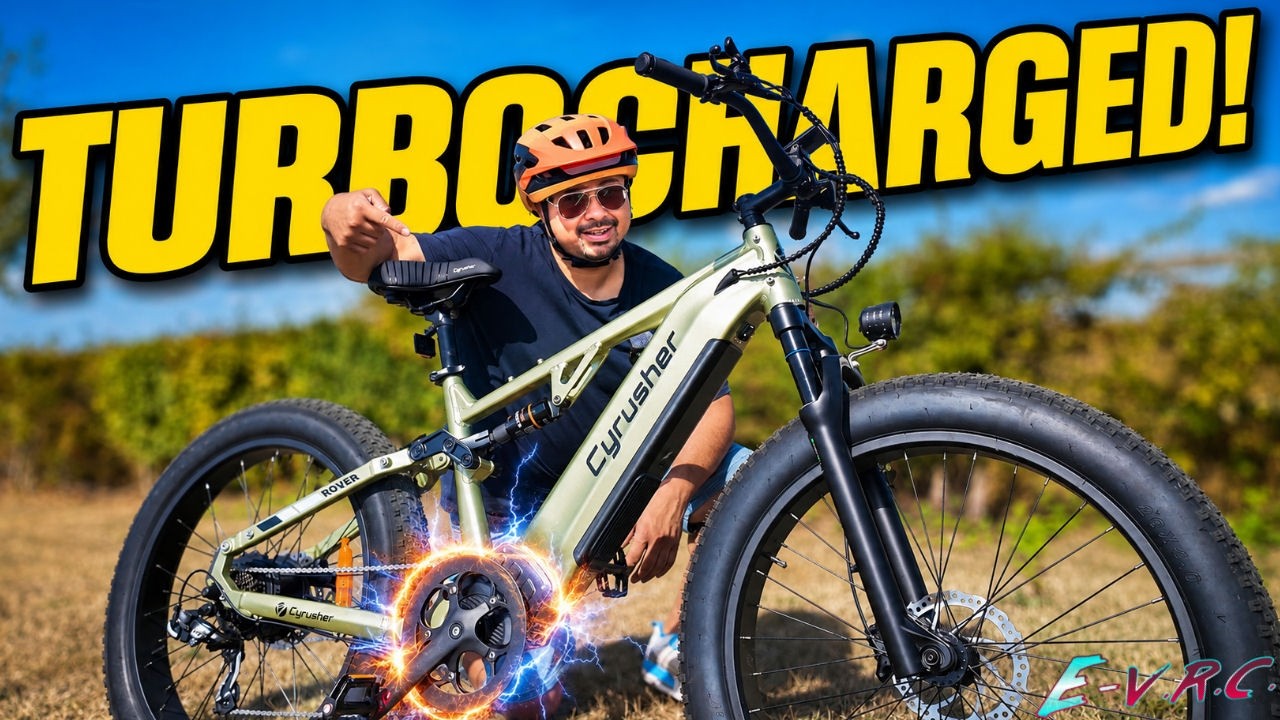
The Cyrusher Rover is an e-bike (priced around £1,500) featuring powerful performance, fat tires (26-inch), and full suspension. It is the “step-over” (non-step-through) version of the earlier Rome model.
The reviewer praises its rugged appearance, ample power, ride comfort, and excellent range, though notes some “minor yet annoying” flaws (such as overly aggressive torque sensor tuning, a loose chain prone to rattling and slapping, and the lack of standard mudguards or a rear rack). - Pros and Cons
Pros:
• Powerful and responsive acceleration: Equipped with a 52V battery and a high-torque motor (rated at 95 Nm), it offers almost zero lag when starting.
• Excellent full-suspension system: The rear suspension tuning is surprisingly smooth and comfortable; combined with 4-inch wide tires, it delivers a great off-road experience.
• Impressive real-world range: With an 811 Wh high-capacity battery (52V 15.6Ah), the reviewer (weighing over 100kg) easily achieved a range of about 60 miles (nearly 100 km).
• Wide rider height compatibility: The frame and saddle offer extensive adjustability, accommodating riders from 5’4" to nearly 6’6" comfortably.
• Outstanding design: Features internal cable routing, a rugged frame profile, and a cohesive, unified look.
• Display and lighting: The dashboard is clear and readable in sunlight, and the high-brightness taillight includes a brake light function.
Cons:
• Overly aggressive sensor tuning (like “steroid-fueled” cadence sensing): The torque sensor reacts too aggressively, delivering full power even with very slow pedaling, which makes fine speed control difficult.
• Chain prone to rattling/noise and dropping: Significant chain noise occurs when riding over bumpy terrain, and the chain even dropped off during testing. • Heavy build: The bike weighs approximately 39 kg, making it difficult to carry up stairs (though the battery is removable).
• Accessories not included: Mudguards and a rear rack are not included and must be purchased separately.
• Basic drivetrain: It uses an entry-level Shimano Tourney 7-speed derailleur.
[00:00] - [02:18] Initial impressions of the torque sensor and control issues: The reviewer tested the sensor’s response speed; while it engages instantly, even light “ghost pedaling” causes immediate acceleration to around 15.5–16 mph, lacking the fine low-speed control typical of torque sensors (performance improved only when switched to assist level 1).
[02:19] - [05:20] Model positioning and specifications: Compared to other Cyrusher models (such as the Rome, Komoda, and Flex), the Rover is introduced as a bike featuring 26-inch fat tires, dual suspension, and a 52V battery, with a factory-set limit of 250W (compliant with UK regulations, though it can be manually unlocked).
[05:21] - [07:10] Suspension system test: The dual suspension was tested on bumpy and potholed roads; the rear suspension offered excellent shock absorption, though significant chain slap noise was noted.
[07:11] - [08:56] Hill-climbing power test: Motor output was tested on a steep incline using “cadence-only/ghost pedaling” mode; the bike easily reached the summit at 13–15.5 mph.
[08:57] - [10:45] Unexpected chain drop and range/data analysis: The chain fell off during testing; the reviewer reinstalled it and commented that the manufacturer’s claimed range of “62 miles/100 km” is often overly optimistic. [10:46] - [14:14] Weight, battery removal, rider height compatibility, and design: The measured weight is approximately 39 kg, with a maximum load capacity of 160 kg. It features a 52V 15.6Ah (811Wh) battery. With no suspension components obstructing the area beneath the seat post, the saddle offers a wide range of height adjustments, accommodating riders from 5’4" to nearly 6’6" tall. The build quality is neat, with no messy cable routing.
[14:15] - [18:38] Mode switching, brakes, and sensor limitations: Testing the switch between pedal-assist (PAS) and torque-sensing modes, as well as hydraulic brake performance; the reviewer reiterates that the lack of sensor tuning options is the bike’s main drawback.
[18:39] - [20:38] Unboxing accessories and charging test: Overview of included items such as the toolkit, air pump, lights, and rearview mirrors; the included 2A charger takes about 8 hours for a full charge.
[20:39] - [23:18] 0-15 mph acceleration test and handlebar display details: Testing acceleration performance using only motor assistance; demonstrating the high-contrast color display’s visibility in sunlight and its function menus.
[23:19] - [30:23] Real-world range summary and final buying advice: The reviewer rode over 15 miles at maximum assist with negligible battery drain, suggesting a real-world range of around 60 miles is achievable. Given the £1,500 price point, the reviewer considers this a high-value fat-tire e-bike, ideal for users who prioritize powerful performance and off-road riding.